

Denver Restraining Order Lawyers — Protection Orders in Denver County
A restraining order in Denver can restrict your housing, your contact with family members, your access to your children, and your ability to possess firearms. In Denver’s competitive housing and employment market, a protection order that appears in background checks can also affect apartment applications and certain employment opportunities. Civil protection orders and criminal restraining orders each carry their own standards and consequences — and Denver’s specialized Domestic Violence Court creates a specific protection order environment for DV-related orders that is unlike most other Colorado jurisdictions. Burnham Law’s Denver restraining order attorneys represent petitioners seeking protection and respondents defending against orders throughout Denver County, with specific expertise in how protection orders interact with Denver’s DV Court.
Meet our Denver criminal defense team below — attorneys experienced in protection order proceedings throughout Denver County District Court and Denver’s Domestic Violence Court.

Partner - Domestic Relations and Criminal Defense
Colorado Springs
Jeremy Wooten, is a seasoned trial attorney who specializes in criminal defense and family law, leveraging a wealth of experience honed over five years at the Colorado State Public Defenders’ Office. Rising to Senior Deputy Public Defender, he successfully managed a diverse caseload, including serious charges like first-degree homicide, drug distribution, and economic crimes, always maintaining an unwavering commitment to client advocacy. Licensed in both Texas and Colorado, Jeremy's legal expertise is defined by strategic planning—meticulously crafting and executing well-thought-out trial strategies—and remarkable resourcefulness in finding innovative solutions to complex legal challenges in both the criminal and family law arenas. His practice is characterized by agile, client-centered advocacy, which relies on adaptability, active listening, and quick thinking essential for effective trial work. Jeremy prioritizes thoroughly understanding his clients' objectives and adapting his strategies dynamically to the evolving nature of trials. His resilience and strategic agility allow him to confidently navigate unexpected developments in the courtroom, ensuring each case is expertly...

Senior Associate Attorney - Domestic Relations and Criminal Defense
Colorado Springs
Julian Rosielle has been licensed to practice law in Colorado since 2006. Julian is a graduate of the University of Colorado School of Law, where he was on the Dean’s List and an associate editor of the University of Colorado Law Review. Julian practiced exclusively in the area of criminal law for the first thirteen years of his career and has several notable case outcomes to include not guilty verdicts on charges of homicide and assault. Julian has extensive trial experience, ranging from Death Penalty cases to misdemeanor domestic violence to driving under the influence. Beginning in 2019, Julian’s practice has expanded to include domestic relations litigation and civil protection orders. Julian has lived in Colorado since 2004 and when not in Court enjoys hiking with his family and dogs.

Associate Attorney - Civil Litigation & Criminal Defense
Centennial
Kate strives to have a client-oriented practice where she can assist her clients in all stages of litigation. Prior to joining Burnham, Kate was an associate at an AmLaw Firm where she worked on various types of complex litigation representing large corporations, municipalities, and individuals. Before going into private practice, Kate was an Assistant Public Defender in Miami-Dade County where she tried over twenty cases. Kate has been able to develop a well-rounded practice by working in both the private and public sectors. Kate has honed her skill sets from her prior experience so she can be a zealous advocate for her clients. In her spare time, Kate enjoys spending time with her husband in the outdoors, traveling, and visiting family.
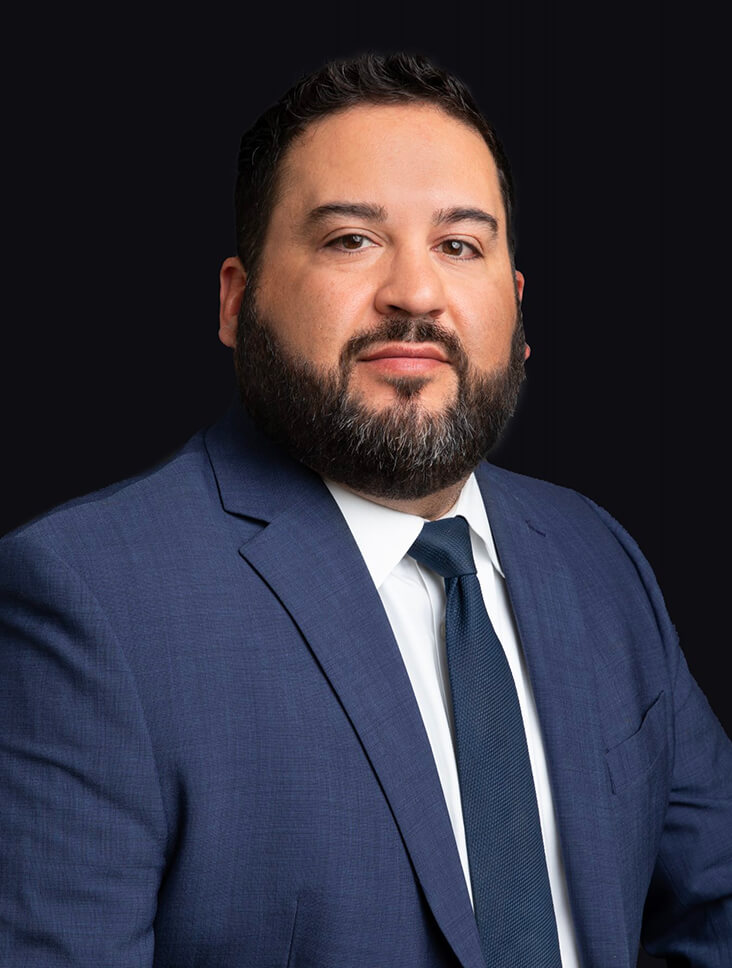
Senior Associate - Domestic Relations & Criminal Defense
Fort Collins
Miguel C. Mondragon is a tenacious and dedicated attorney who is fiercely committed to his clients and their legal outcomes. Recognizing that clients facing divorce or criminal charges are often in their most vulnerable state, Miguel acts as a passionate advocate, ensuring they have a voice within the legal system. Growing up in southern Colorado, Miguel developed a strong work ethic by working in construction, lumber, and brickyards while attending college. Before becoming an attorney, his interest in law was sparked by his work within the Larimer County Corrections system. While attending the University of South Dakota School of Law, he gained valuable experience working with East River Legal Services, the Colorado State Public Defenders Office, and Samuelson Law. Upon graduation, Miguel honed his skills first as a solo practitioner, then at Weaver & Associates, P.C., before founding Mondragon Law, where he specialized in criminal defense and family law. He brings this deep experience and tenacity to his current role...
Restraining Orders and Protection Orders in Colorado
Colorado provides for temporary protection orders (TPOs) — issued ex parte on the same day the petition is filed if a judge finds sufficient grounds — and permanent protection orders (PPOs), issued after a hearing where both parties appear and present evidence. A TPO can issue within hours of filing based solely on the petitioner’s sworn statement. The PPO hearing must be set within 14 days of the TPO. At the PPO hearing, the standard is preponderance of the evidence — the petitioner must show the alleged conduct more likely than not occurred and that continued protection is warranted.
Criminal protection orders are separate — issued automatically by the court in domestic violence, stalking, harassment, and similar criminal cases as a condition of bond or sentence. In Denver, criminal DV protection orders are issued by Denver’s DV Court as part of the mandatory protection order that attaches at the first advisement in every DV case. These criminal protection orders cannot be modified by agreement and remain in effect throughout the criminal case. Violating either type of protection order is a separate criminal offense.
Denver’s DV Court creates a specific protection order environment for DV-related civil and criminal orders. Civil protection orders that arise from domestic or intimate partner situations in Denver are often heard by the same judges who handle criminal DV cases — judges with deep familiarity with DV dynamics, DV evidence law, and the specific patterns of intimate partner violence. This specialized judicial expertise creates a different PPO hearing environment than in jurisdictions where general judges handle protection order matters.
What Our Denver Restraining Order Attorneys Handle
Defending against civil protection orders: When a protection order petition has been filed against you in Denver County District Court, we appear immediately, contest the TPO where the facts support it, and prepare aggressively for the PPO hearing. We challenge the factual basis, present the respondent’s evidence and perspective, and argue against orders that are inaccurate, exaggerated, or being used for tactical purposes in connection with parallel DV or family law proceedings.
Petitioning for civil protection orders: When you need legal protection in Denver, we help you prepare a thorough, well-documented petition and represent you effectively at the TPO and PPO stages. Denver’s DV Court experience means petitioner representation in DV-related protection orders benefits from the same specialized court knowledge we bring to respondent defense.
DV Court protection order defense: Protection orders issued through Denver’s DV Court — as mandatory criminal protection orders in DV cases — are contested and modified through the DV Court’s own procedures. We challenge overbroad DV Court protection order conditions and petition for modification when circumstances change.
Protection order violation defense: Violations of protection orders — civil or criminal — are separate criminal offenses in Colorado. We defend protection order violation charges in both Denver County Court (for criminal misdemeanor violations) and Denver District Court (for felony violations), challenging the sufficiency of the evidence that a violation occurred.
Modification of existing orders: Circumstances change, and protection orders that were appropriate when entered may need modification as the underlying situation evolves. We petition for modification of both civil and criminal protection orders in Denver County when changed circumstances warrant it.
Protection Orders and Denver’s DV Court
Denver’s DV Court creates a unique protection order environment. Civil protection order petitions in Denver that arise from intimate partner situations are sometimes consolidated with or heard by the same judges who handle criminal DV matters — creating a judicial familiarity with DV dynamics and evidence that affects how PPO hearings are conducted and what evidence the court finds most persuasive.
The mandatory protection order issued at the first DV Court advisement in a criminal DV case is a criminal court order — distinct from a civil protection order but with similar practical restrictions. It cannot be modified by agreement between the parties, and both the petitioner and the respondent must go through the DV Court to seek any modification. The DV victim advocates who work within Denver’s DV Court have a role in these proceedings that doesn’t exist in general criminal courts — they may be present at hearings, may communicate with the alleged victim, and may be involved in the court’s evaluation of protection order modifications.
Understanding how Denver’s DV Court handles protection order matters — both civil and criminal — and how to present effective arguments for or against these orders in Denver’s specialized judicial environment is part of what distinguishes Denver protection order representation from generic Colorado protection order practice.
Why Burnham Law for Restraining Orders in Denver
Denver DV Court protection order expertise. We understand how Denver’s DV Court handles both civil and criminal protection orders — its judges’ tendencies, the DV prosecution unit’s approach to modification requests, and the role of victim advocates in the court’s process. That specific knowledge is the foundation of effective Denver protection order representation.
Both sides of protection order proceedings. We represent petitioners seeking protection and respondents defending against orders in both Denver County District Court and Denver’s DV Court. Experience on both sides makes us more effective on whichever side we represent.
Rapid response to TPOs. The 14-day window from TPO to PPO hearing is compressed. We move immediately upon being retained, evaluate the petition, gather evidence, and prepare for the PPO hearing in Denver’s courts with the urgency the compressed timeline demands.
Federal firearms prohibition awareness. The federal firearms prohibition that attaches to qualifying protection orders — including Denver DV Court orders — is a consequence we address explicitly in every relevant Denver protection order case, treating it as a primary concern for clients whose employment or personal circumstances involve firearms.
Frequently Asked Questions — Denver Restraining Orders
How quickly can a protection order be issued in Denver?
A temporary protection order can be issued by Denver County District Court on the same day the petition is filed if a judge finds sufficient grounds in the petitioner’s sworn statement. The petition is reviewed ex parte — without the other party present — and the TPO can issue within hours of filing. Law enforcement then serves the order on the respondent. The PPO hearing must be set within 14 days of the TPO. For DV Court criminal protection orders, the mandatory protection order is issued at the first advisement — typically within 48 hours of a DV arrest in Denver.
How does Denver’s DV Court affect civil protection order proceedings?
Civil protection order petitions in Denver that arise from intimate partner situations may be heard by DV Court-affiliated judges with deep expertise in DV dynamics and evidence. This specialized judicial background affects how PPO hearings are conducted — these judges have extensive experience with DV case patterns and may evaluate evidence and arguments differently than general judges hearing occasional protection order matters. Effective protection order representation in Denver benefits from knowledge of how these specialized judges approach civil protection order hearings.
Can a Denver protection order be contested at the PPO hearing?
Yes. At the permanent protection order hearing in Denver County District Court, the respondent has the right to appear, present evidence, call witnesses, and be represented by counsel. The petitioner must establish the case by preponderance of the evidence. A well-prepared respondent with credible evidence challenging the petitioner’s account has a genuine opportunity to prevent issuance of a permanent protection order in Denver’s courts. Denver’s DV Court judges hear both sides at PPO hearings and do not automatically grant permanent orders simply because a TPO was issued.
What is the federal firearms prohibition and how does it apply to Denver protection orders?
Federal law — 18 U.S.C. § 922(g)(8) — prohibits any person subject to a qualifying court order from possessing firearms while that order is in effect. A qualifying order is one issued after a hearing, directed against an intimate partner or child, and finding that the person represents a credible threat or explicitly prohibiting physical force. Both qualifying civil protection orders from Denver County District Court and qualifying criminal protection orders from Denver’s DV Court can trigger this prohibition while they are in effect. For Denver residents whose employment or personal circumstances involve firearms, a qualifying protection order has immediate practical consequences that we address explicitly in every relevant Denver protection order case.
Can a Denver protection order affect housing and employment?
Yes. Protection orders from Denver County District Court are public court records entered into the Colorado protection order registry. They may appear in certain background checks — particularly for employment in law enforcement, security, and positions involving trust determinations. A protection order that requires a respondent to vacate a shared residence creates immediate housing displacement in Denver’s competitive housing market. The federal firearms prohibition that attaches to qualifying orders has employment consequences in firearms-related occupations. We address the full range of practical consequences — not just the legal restrictions — in every Denver protection order case.
Schedule a Consultation with a Denver Restraining Order Lawyer
Whether you need a protection order in Denver or you’re defending against one — including through Denver’s specialized DV Court — the proceedings move quickly and require attorneys who know how Denver’s specific court environment operates. Burnham Law’s Denver attorneys are ready to act immediately for both petitioners and respondents.
Call (303) 990-5308 or schedule a confidential consultation online. We handle protection order proceedings throughout Denver County District Court and Denver’s Domestic Violence Court.