

Colorado Springs Domestic Violence Lawyers — DV Defense in El Paso County
Domestic violence charges in Colorado Springs carry two sets of potentially devastating consequences — the criminal case in El Paso County District Court, and for the significant military population in this city, the parallel military career consequences that a DV conviction triggers. Colorado’s mandatory arrest law, its victim-independent prosecution model, and the federal Lautenberg Amendment’s firearm prohibition make domestic violence cases uniquely dangerous for military personnel and defense contractors. A misdemeanor DV conviction ends military careers. Burnham Law’s Colorado Springs domestic violence defense attorneys fight these cases from the first call — understanding both the civilian and military stakes.
Meet our Colorado Springs criminal defense team below — attorneys experienced in domestic violence defense throughout El Paso County District Court.

Partner - Domestic Relations and Criminal Defense
Colorado Springs
Jeremy Wooten, is a seasoned trial attorney who specializes in criminal defense and family law, leveraging a wealth of experience honed over five years at the Colorado State Public Defenders’ Office. Rising to Senior Deputy Public Defender, he successfully managed a diverse caseload, including serious charges like first-degree homicide, drug distribution, and economic crimes, always maintaining an unwavering commitment to client advocacy. Licensed in both Texas and Colorado, Jeremy's legal expertise is defined by strategic planning—meticulously crafting and executing well-thought-out trial strategies—and remarkable resourcefulness in finding innovative solutions to complex legal challenges in both the criminal and family law arenas. His practice is characterized by agile, client-centered advocacy, which relies on adaptability, active listening, and quick thinking essential for effective trial work. Jeremy prioritizes thoroughly understanding his clients' objectives and adapting his strategies dynamically to the evolving nature of trials. His resilience and strategic agility allow him to confidently navigate unexpected developments in the courtroom, ensuring each case is expertly...

Senior Associate Attorney - Domestic Relations and Criminal Defense
Colorado Springs
Julian Rosielle has been licensed to practice law in Colorado since 2006. Julian is a graduate of the University of Colorado School of Law, where he was on the Dean’s List and an associate editor of the University of Colorado Law Review. Julian practiced exclusively in the area of criminal law for the first thirteen years of his career and has several notable case outcomes to include not guilty verdicts on charges of homicide and assault. Julian has extensive trial experience, ranging from Death Penalty cases to misdemeanor domestic violence to driving under the influence. Beginning in 2019, Julian’s practice has expanded to include domestic relations litigation and civil protection orders. Julian has lived in Colorado since 2004 and when not in Court enjoys hiking with his family and dogs.

Associate Attorney - Civil Litigation & Criminal Defense
Centennial
Kate strives to have a client-oriented practice where she can assist her clients in all stages of litigation. Prior to joining Burnham, Kate was an associate at an AmLaw Firm where she worked on various types of complex litigation representing large corporations, municipalities, and individuals. Before going into private practice, Kate was an Assistant Public Defender in Miami-Dade County where she tried over twenty cases. Kate has been able to develop a well-rounded practice by working in both the private and public sectors. Kate has honed her skill sets from her prior experience so she can be a zealous advocate for her clients. In her spare time, Kate enjoys spending time with her husband in the outdoors, traveling, and visiting family.
Senior Associate - Domestic Relations & Criminal Defense
Fort Collins
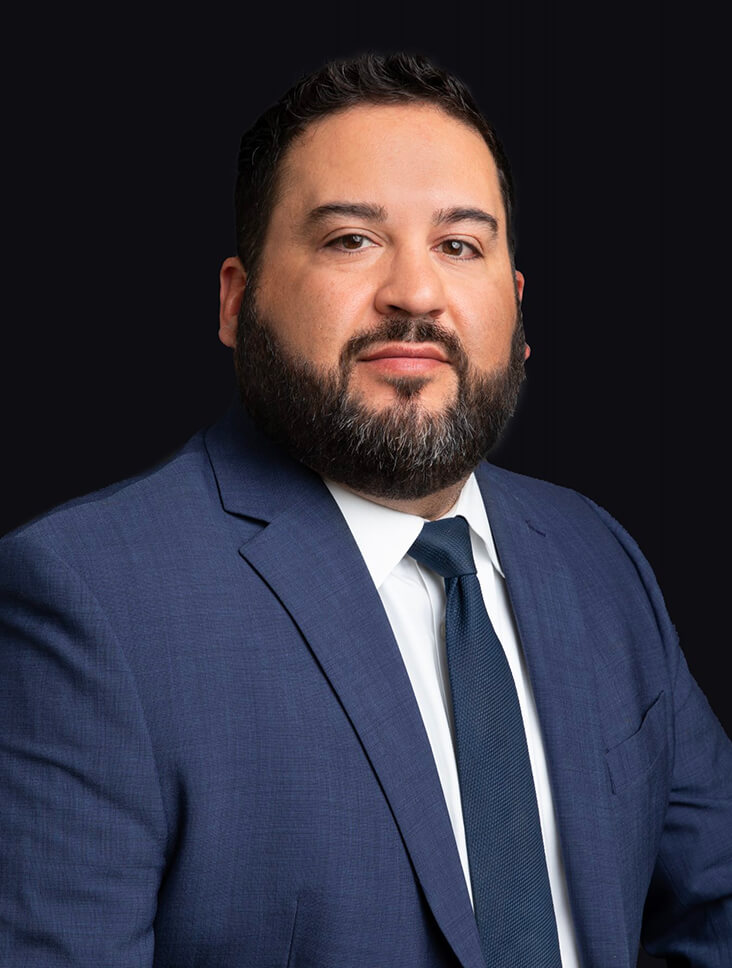
Miguel C. Mondragon is a tenacious and dedicated attorney who is fiercely committed to his clients and their legal outcomes. Recognizing that clients facing divorce or criminal charges are often in their most vulnerable state, Miguel acts as a passionate advocate, ensuring they have a voice within the legal system. Growing up in southern Colorado, Miguel developed a strong work ethic by working in construction, lumber, and brickyards while attending college. Before becoming an attorney, his interest in law was sparked by his work within the Larimer County Corrections system. While attending the University of South Dakota School of Law, he gained valuable experience working with East River Legal Services, the Colorado State Public Defenders Office, and Samuelson Law. Upon graduation, Miguel honed his skills first as a solo practitioner, then at Weaver & Associates, P.C., before founding Mondragon Law, where he specialized in criminal defense and family law. He brings this deep experience and tenacity to his current role...
Domestic Violence Charges in Colorado
In Colorado, domestic violence is not a standalone offense — it is a designation applied to virtually any criminal charge when committed against an intimate partner. Assault, harassment, menacing, criminal mischief, stalking, and telephone harassment can all carry the DV designation. The designation triggers mandatory consequences that don’t apply to the same offenses without it — automatic protection orders, mandatory treatment upon conviction, and the federal firearm prohibition that makes DV convictions uniquely dangerous for military personnel.
Colorado’s mandatory arrest statute (C.R.S. § 18-6-803.6) requires police to arrest the dominant physical aggressor when they have probable cause to believe domestic violence occurred — regardless of whether the alleged victim wants an arrest. The alleged victim’s preferences do not control prosecution decisions. The El Paso County DA’s office can and regularly does prosecute DV cases using 911 recordings, body camera footage, photographs, and officer observations — independent of the alleged victim’s cooperation or desire to proceed.
The Lautenberg Amendment’s federal firearm prohibition applies to anyone convicted of a misdemeanor crime of domestic violence — permanently. For active duty military in Colorado Springs, this is a career-ending consequence. Service members are required to carry weapons as part of their duty. A Lautenberg-disqualified service member cannot perform this duty and faces immediate administrative action, typically resulting in separation from service. Even civilian defense contractors who need access to weapons on federal installations face immediate employment loss from a misdemeanor DV conviction.
What Our Colorado Springs DV Defense Attorneys Handle
Challenging the initial evidence: Many DV arrests are based on a single account of a disputed incident. We investigate thoroughly — obtaining 911 recordings, body camera footage, incident photographs, medical records, and statements from all available witnesses — to build the most accurate and complete picture of what actually occurred.
First appearance and protection order: The mandatory protection order issued at the first advisement can require a service member to vacate base housing, prohibit contact with family members, and restrict firearm possession — immediate operational consequences. We appear at the first advisement and argue for the least restrictive conditions the court will allow.
Defending when the alleged victim recants: The alleged victim’s decision to recant or not cooperate does not end the prosecution in Colorado. We understand how to defend cases where the prosecution proceeds using prior statements, excited utterances, and independent evidence — and how to use the alleged victim’s lack of cooperation effectively where the evidentiary rules allow.
Lautenberg Amendment protection: Protecting the client’s ability to possess firearms — and for military clients, their ability to serve — is often the most important goal in DV defense. We structure every aspect of the defense and any plea negotiations with explicit attention to avoiding the Lautenberg Amendment trigger.
Coordinating military and civilian defense: DV charges against military personnel in Colorado Springs trigger command notification, potential UCMJ action, and administrative proceedings that run parallel to the civilian case. We coordinate civilian DV defense with awareness of the military administrative track to protect the client’s overall position.
Domestic Violence and Military Service in Colorado Springs
The intersection of domestic violence charges and military service creates a category of cases that is specific to Colorado Springs’ community in ways that most criminal defense attorneys outside this market never encounter. Fort Carson, the Air Force Academy, Peterson and Schriever Space Force Bases collectively employ tens of thousands of service members, many of whom live in the surrounding civilian community and are subject to El Paso County civilian criminal jurisdiction.
A DV arrest triggers immediate command notification in most cases — the service member’s commanding officer learns of the arrest, which initiates a separate administrative track independent of the civilian criminal proceedings. Even if the civilian case is ultimately dismissed or results in acquittal, the command may take administrative action based on the underlying conduct. A conviction, however, virtually guarantees the most severe administrative consequences — separation in most cases.
Understanding the interaction between the civilian criminal defense and the military administrative process is essential for military DV clients. Actions taken in the civilian case — what statements are made, what pleas are entered, what the final disposition is — all affect the military administrative proceedings. We develop civilian DV defense strategy with full awareness of the military track and advise clients on both simultaneously.
Why Burnham Law for DV Defense in Colorado Springs
Lautenberg Amendment defense focus. The federal firearm prohibition that attaches to a misdemeanor DV conviction is the most serious career consequence for military personnel. We address it explicitly in every defense strategy and make protecting firearms rights a primary goal of plea negotiations.
Military-civilian defense coordination. We understand how civilian DV proceedings interact with military administrative processes — command notification, UCMJ action, administrative separation — and develop strategy that protects the client’s overall position across both systems.
Colorado mandatory prosecution model knowledge. Colorado’s victim-independent prosecution model requires defense attorneys who understand how to defend cases when the prosecution uses independent evidence — 911 calls, body camera, photographs — without alleged victim cooperation. We have that experience.
Fast response at first appearance. The first advisement sets critical terms — bond, protection order conditions, and the initial framing of the case. We appear at first advisements in El Paso County and argue aggressively for the least restrictive conditions from the outset.
Frequently Asked Questions — Colorado Springs Domestic Violence Defense
Why can’t the alleged victim just drop the charges in Colorado?
In Colorado, the alleged victim does not control whether charges are filed or prosecuted. The El Paso County DA’s office makes prosecution decisions independently based on the available evidence — which can include the victim’s original statements, 911 recordings, body camera footage, photographs of injuries, and officer observations. The prosecution can and regularly does proceed with DV cases even when the alleged victim recants, refuses to cooperate, or asks that charges be dropped. An experienced DV defense attorney knows how to defend these cases under Colorado’s mandatory prosecution model.
What happens to a military member’s career when charged with domestic violence in Colorado Springs?
A DV arrest in Colorado Springs typically triggers command notification within days or weeks. The service member may face immediate administrative action — removal from certain duties, restriction to installation, or other measures — while the civilian case is pending. A DV conviction triggers the Lautenberg Amendment’s permanent firearm prohibition, which disqualifies the service member from bearing arms and virtually guarantees administrative separation. Even a civilian dismissal or acquittal may not prevent administrative action if the command determines the underlying conduct violated the UCMJ. Aggressive civilian defense that results in dismissal or significant charge reduction is the best protection against military career consequences.
What is the mandatory protection order in a Colorado DV case?
Colorado law requires the court to issue a mandatory protection order at the first appearance in any domestic violence case. This order prohibits the defendant from contacting the alleged victim, typically requires vacating a shared residence, and prohibits firearm possession. For military personnel, the order may require vacating base housing and can restrict access to service weapons — immediate operational consequences. Violations of the mandatory protection order are separate criminal offenses. We appear at first advisements and argue for the least restrictive conditions the court will allow.
What is the Lautenberg Amendment and why does it matter so much in Colorado Springs?
The Lautenberg Amendment is a federal law that permanently prohibits anyone convicted of a misdemeanor crime of domestic violence from possessing firearms. This federal prohibition applies to everyone — including military personnel and law enforcement officers — regardless of the civilian sentence. For military personnel in Colorado Springs, whose job duties require carrying weapons, a Lautenberg-triggered prohibition means they cannot perform their duties and face immediate administrative separation. This makes avoiding a DV conviction — or at minimum avoiding a conviction that qualifies as a misdemeanor crime of domestic violence — the most important goal in many Colorado Springs DV defense cases.
Can a domestic violence charge be dismissed in El Paso County?
Yes. DV charges are dismissed in El Paso County through pretrial suppression motions that exclude key evidence, through the DA’s determination that the evidence is insufficient to proceed, through diversion in appropriate cases, and through acquittal at trial. The availability of these routes depends on the specific facts, the evidence available to the prosecution, and the defendant’s history. For first-time defendants with no criminal history and genuinely disputed facts, dismissal through negotiation or diversion is a realistic goal with the right defense attorney.
Schedule a Consultation with a Colorado Springs Domestic Violence Lawyer
Domestic violence charges in Colorado Springs require experienced defense from the moment of arrest — particularly for military personnel for whom the civilian and military consequences are both severe and immediate. Burnham Law’s Colorado Springs DV defense attorneys act quickly when it matters most.
Call (303) 990-5308 or schedule a confidential consultation online. We defend domestic violence charges throughout El Paso County.