

Boulder Drug Offense Lawyers — Drug Charge Defense in Boulder County
Boulder’s progressive reputation around cannabis and drug policy can create a misleading impression about how drug charges are prosecuted here. The Boulder County DA’s office actively prosecutes drug distribution, trafficking, and campus-area offenses — and even simple possession charges, while reformed at the state level, carry consequences for employment, housing, professional licensing, and student standing that require serious defense attention. Burnham Law’s Boulder drug offense attorneys defend clients at every level of drug charge severity in Boulder County District Court, from marijuana-related offenses and simple possession to serious felony distribution and trafficking cases.
Meet our Boulder criminal defense team below — attorneys experienced in drug offense defense throughout Boulder County District Court and the 20th Judicial District.
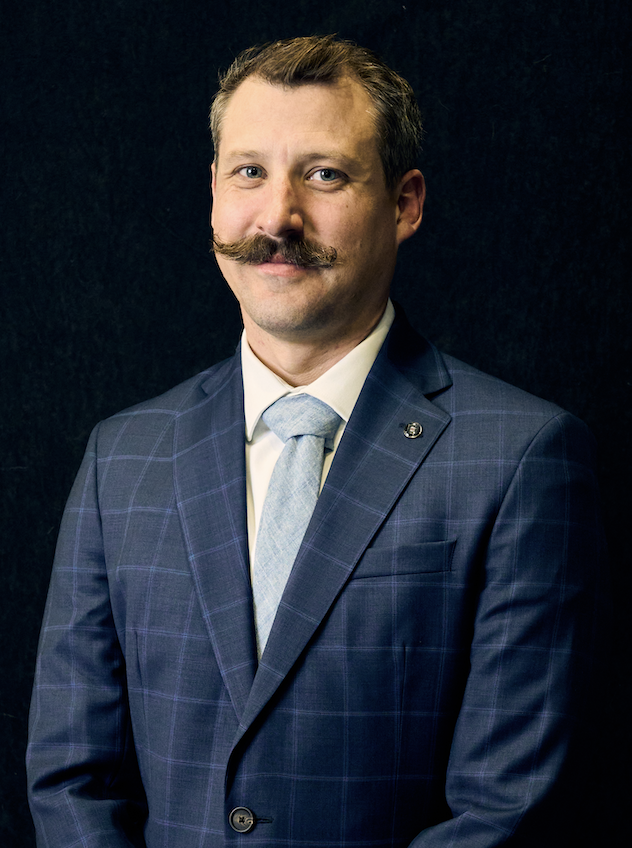
Partner - Domestic Relations and Criminal Defense
Colorado Springs
Jeremy Wooten, is a seasoned trial attorney who specializes in criminal defense and family law, leveraging a wealth of experience honed over five years at the Colorado State Public Defenders’ Office. Rising to Senior Deputy Public Defender, he successfully managed a diverse caseload, including serious charges like first-degree homicide, drug distribution, and economic crimes, always maintaining an unwavering commitment to client advocacy. Licensed in both Texas and Colorado, Jeremy's legal expertise is defined by strategic planning—meticulously crafting and executing well-thought-out trial strategies—and remarkable resourcefulness in finding innovative solutions to complex legal challenges in both the criminal and family law arenas. His practice is characterized by agile, client-centered advocacy, which relies on adaptability, active listening, and quick thinking essential for effective trial work. Jeremy prioritizes thoroughly understanding his clients' objectives and adapting his strategies dynamically to the evolving nature of trials. His resilience and strategic agility allow him to confidently navigate unexpected developments in the courtroom, ensuring each case is expertly...

Senior Associate Attorney - Domestic Relations and Criminal Defense
Colorado Springs
Julian Rosielle has been licensed to practice law in Colorado since 2006. Julian is a graduate of the University of Colorado School of Law, where he was on the Dean’s List and an associate editor of the University of Colorado Law Review. Julian practiced exclusively in the area of criminal law for the first thirteen years of his career and has several notable case outcomes to include not guilty verdicts on charges of homicide and assault. Julian has extensive trial experience, ranging from Death Penalty cases to misdemeanor domestic violence to driving under the influence. Beginning in 2019, Julian’s practice has expanded to include domestic relations litigation and civil protection orders. Julian has lived in Colorado since 2004 and when not in Court enjoys hiking with his family and dogs.

Associate Attorney - Civil Litigation & Criminal Defense
Centennial
Kate strives to have a client-oriented practice where she can assist her clients in all stages of litigation. Prior to joining Burnham, Kate was an associate at an AmLaw Firm where she worked on various types of complex litigation representing large corporations, municipalities, and individuals. Before going into private practice, Kate was an Assistant Public Defender in Miami-Dade County where she tried over twenty cases. Kate has been able to develop a well-rounded practice by working in both the private and public sectors. Kate has honed her skill sets from her prior experience so she can be a zealous advocate for her clients. In her spare time, Kate enjoys spending time with her husband in the outdoors, traveling, and visiting family.
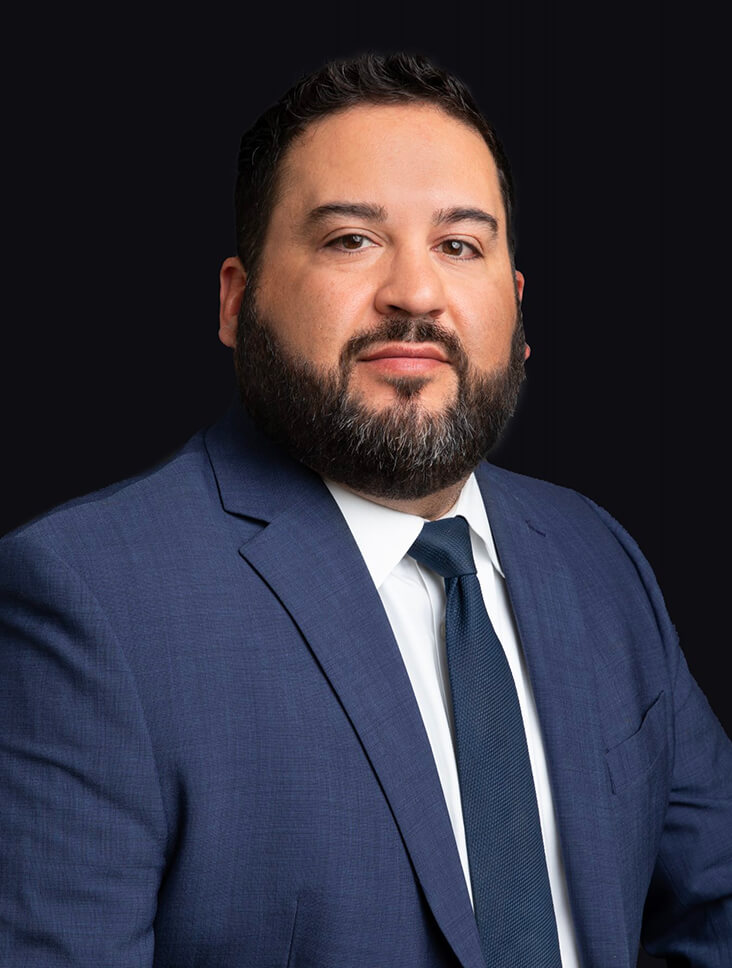
Senior Associate - Domestic Relations & Criminal Defense
Fort Collins
Miguel C. Mondragon is a tenacious and dedicated attorney who is fiercely committed to his clients and their legal outcomes. Recognizing that clients facing divorce or criminal charges are often in their most vulnerable state, Miguel acts as a passionate advocate, ensuring they have a voice within the legal system. Growing up in southern Colorado, Miguel developed a strong work ethic by working in construction, lumber, and brickyards while attending college. Before becoming an attorney, his interest in law was sparked by his work within the Larimer County Corrections system. While attending the University of South Dakota School of Law, he gained valuable experience working with East River Legal Services, the Colorado State Public Defenders Office, and Samuelson Law. Upon graduation, Miguel honed his skills first as a solo practitioner, then at Weaver & Associates, P.C., before founding Mondragon Law, where he specialized in criminal defense and family law. He brings this deep experience and tenacity to his current role...
Drug Laws in Colorado
Colorado’s Drug Code classifies controlled substances into five schedules based on medical use and abuse potential. Under Colorado’s SB 19-013 reforms, simple possession of most Schedule I or II substances is a level 1 drug misdemeanor for a first or second offense — carrying up to 180 days in jail and treatment alternatives. A third or subsequent possession offense can be charged as a level 4 drug felony. Distribution, manufacturing, and trafficking charges remain felonies at every level, with sentences from level 4 drug felony (6 months to 2 years) to level 1 drug felony (8 to 32 years) depending on the substance and quantity.
Marijuana is legal in Colorado for adults 21 and over in amounts up to one ounce. Possession above the legal limit, distribution without a license, sale to minors, and use in public or in a vehicle remain criminal offenses. Near CU’s campus — which sits within the jurisdiction of both Boulder city police and CU Police — marijuana possession and distribution issues arise regularly, including situations where the amounts involved cross from legal possession into criminal territory. The intersection of CU’s own drug policies with Colorado state law creates complexity for student defendants that requires careful navigation.
Drug offenses committed in drug-free school zones in Colorado carry enhanced penalties. CU’s campus and the surrounding Boulder neighborhoods fall within school zone proximity for enforcement purposes. Distribution charges near campus are prosecuted as a priority by the Boulder County DA, and the school zone enhancement can significantly increase the potential sentence above the base drug felony range.
What Our Boulder Drug Defense Attorneys Challenge
Fourth Amendment search and seizure: The vast majority of drug cases rest on physical drug evidence. If that evidence was obtained through an unlawful stop, unlawful vehicle search, unlawful home search, or unlawful pat-down, the Fourth Amendment requires its suppression. Suppression of the drug evidence typically ends the prosecution. We scrutinize every Boulder drug case for constitutional violations from the moment we are retained.
CU-specific search issues: Drug evidence obtained through CU campus searches — by CU Police or other law enforcement — must satisfy the same Fourth Amendment requirements as any other search. Dorm room searches, searches incident to arrest on campus, and searches based on tips raise specific constitutional issues that we evaluate in every campus-area drug case.
Laboratory analysis: The prosecution must prove through certified laboratory analysis that the substance was what law enforcement claimed. We review lab reports for methodology, analyst qualifications, and testing standards, and challenge results when those reviews reveal deficiencies.
School zone proximity: School zone enhancements require proof that the offense occurred within the specified distance of a school or other qualifying institution. We challenge the measurement and the application of the school zone enhancement when the facts support it.
Intent to distribute evidence: Distribution charges often rest on quantity combined with packaging materials, scales, or currency. We challenge both the weight calculations and the sufficiency of the evidence of intent to distribute versus personal use.
How Drug Cases Work in Boulder County
Drug offense cases in Boulder County range from first-offense possession matters where diversion and treatment alternatives are actively available to complex distribution investigations with multiple defendants, surveillance evidence, and confidential informants. The 20th Judicial District’s rehabilitative orientation means that diversion and treatment-based alternatives to incarceration are actively used here — particularly for possession offenses — creating real opportunities for eligible defendants that must be identified and pursued.
For CU student defendants, drug cases present a dual-track challenge: the criminal case in Boulder County District Court and the university conduct process that operates in parallel. CU has its own drug policies and conduct procedures that can result in sanctions — including suspension or expulsion — independent of the criminal outcome. We advise CU student clients on both tracks and develop strategy that addresses both simultaneously.
For distribution and felony drug cases, the defense focus shifts to suppression motions, evidence challenge, and — when appropriate — negotiation for reduced charges or sentences that avoid the most serious felony consequences. The school zone enhancement near CU’s campus is a specific issue in many Boulder drug distribution cases that requires attention in both the suppression analysis and the plea negotiation.
Why Burnham Law for Drug Defense in Boulder
Fourth Amendment suppression focus. Drug cases turn on whether the search was constitutional. We file thorough suppression motions in every drug case where a constitutional issue exists and achieve suppression results with enough regularity that it affects how opposing counsel evaluates our cases.
CU campus drug case experience. Campus-area drug cases in Boulder — involving CU Police, dorm room searches, school zone enhancements, and the parallel university conduct process — have specific characteristics that require experience with this particular enforcement and prosecution environment.
20th Judicial District diversion advocacy. Boulder County’s active diversion programs create genuine alternatives to conviction for eligible drug possession defendants. We know these programs and advocate aggressively for our clients’ access to the best available path to dismissal.
Professional and student consequence management. Drug convictions affect employment, housing, professional licensing, and academic standing in ways specific to Boulder’s community. We address these consequences explicitly in every drug defense strategy.
Frequently Asked Questions — Boulder Drug Offenses
Does Boulder’s progressive culture mean drug charges are handled more leniently here?
Boulder’s reputation around cannabis and drug policy does not mean drug charges are handled leniently. The 20th Judicial District actively prosecutes drug distribution, campus-area drug offenses, and trafficking cases with significant resources. The distinction is that Boulder County uses diversion and treatment alternatives more actively than some other Colorado jurisdictions for possession offenses — giving eligible first-time defendants more realistic paths to dismissal. Distribution and trafficking charges are prosecuted seriously regardless of Boulder’s general culture.
What are the drug laws on CU’s campus in Boulder?
CU’s campus is subject to both Colorado state law and the university’s own policies, which in some respects are more restrictive than state law. Despite Colorado’s recreational marijuana legalization, CU prohibits marijuana possession and use on campus under federal law requirements tied to federal funding. CU Police have jurisdiction on campus and work alongside Boulder city police. Drug offenses on campus can result in both criminal charges and university conduct sanctions — potentially including suspension or expulsion — under the university’s separate process.
What is the school zone drug enhancement in Colorado?
Colorado law provides for enhanced penalties when drug distribution offenses occur within a specified distance of a school, university, or other qualifying institution. CU’s campus and the surrounding Boulder neighborhoods fall within school zone proximity for many locations where drug offenses are detected. The school zone enhancement can significantly increase the potential sentence above the base drug felony range. We challenge school zone enhancement applications when the facts don’t establish the required proximity or when the measurement is inaccurate.
Can a drug conviction affect financial aid for CU students?
Yes. Under the Higher Education Act, certain drug convictions can affect federal financial aid eligibility. A conviction for drug possession or sale that occurred while the student was receiving federal aid can result in temporary ineligibility for grants, loans, and work-study. The suspension period depends on whether it is a first, second, or subsequent offense and whether it is a possession or sale conviction. Students can regain eligibility by completing a qualifying drug rehabilitation program. Avoiding a conviction — through dismissal, diversion, or acquittal — is the most effective way to protect financial aid eligibility.
How does a drug conviction affect professional licensing in Colorado?
Drug convictions can affect professional licenses in medicine, nursing, pharmacy, law, teaching, counseling, social work, and many other licensed professions in Colorado. Licensing boards evaluate drug convictions under their own standards — the specific impact depends on the profession, the nature of the conviction, whether it involved distribution, and how the licensee responds. Some convictions trigger mandatory reporting obligations with immediate effect; others are evaluated on a case-by-case basis. We advise Boulder clients in licensed professions on these consequences as an integral part of drug defense strategy.
Schedule a Consultation with a Boulder Drug Offense Lawyer
Drug charges in Boulder County — from campus-area possession to serious felony distribution — require experienced defense that understands both the law and the specific dynamics of this jurisdiction. Burnham Law’s Boulder drug defense attorneys are ready to evaluate your case and pursue the best available outcome.
Call (303) 990-5308 or schedule a confidential consultation online. We defend drug charges throughout Boulder County and the 20th Judicial District.