

Colorado Springs DUI Lawyers — DUI and DWAI Defense in El Paso County
A DUI arrest in Colorado Springs sets two separate legal processes in motion — a criminal case in El Paso County District Court and a civil license revocation proceeding with the Colorado Department of Revenue. Both require immediate action, and both carry serious consequences for your freedom, your license, and your record. For military personnel stationed at Fort Carson, the Air Force Academy, or Peterson Space Force Base, a DUI conviction carries additional consequences that can end a military career. Burnham Law’s Colorado Springs DUI attorneys defend both proceedings from the moment of arrest.
Meet our Colorado Springs criminal defense team below — attorneys experienced in DUI and DWAI defense throughout El Paso County District Court.

Partner - Domestic Relations and Criminal Defense
Colorado Springs
Jeremy Wooten, is a seasoned trial attorney who specializes in criminal defense and family law, leveraging a wealth of experience honed over five years at the Colorado State Public Defenders’ Office. Rising to Senior Deputy Public Defender, he successfully managed a diverse caseload, including serious charges like first-degree homicide, drug distribution, and economic crimes, always maintaining an unwavering commitment to client advocacy. Licensed in both Texas and Colorado, Jeremy's legal expertise is defined by strategic planning—meticulously crafting and executing well-thought-out trial strategies—and remarkable resourcefulness in finding innovative solutions to complex legal challenges in both the criminal and family law arenas. His practice is characterized by agile, client-centered advocacy, which relies on adaptability, active listening, and quick thinking essential for effective trial work. Jeremy prioritizes thoroughly understanding his clients' objectives and adapting his strategies dynamically to the evolving nature of trials. His resilience and strategic agility allow him to confidently navigate unexpected developments in the courtroom, ensuring each case is expertly...

Senior Associate Attorney - Domestic Relations and Criminal Defense
Colorado Springs
Julian Rosielle has been licensed to practice law in Colorado since 2006. Julian is a graduate of the University of Colorado School of Law, where he was on the Dean’s List and an associate editor of the University of Colorado Law Review. Julian practiced exclusively in the area of criminal law for the first thirteen years of his career and has several notable case outcomes to include not guilty verdicts on charges of homicide and assault. Julian has extensive trial experience, ranging from Death Penalty cases to misdemeanor domestic violence to driving under the influence. Beginning in 2019, Julian’s practice has expanded to include domestic relations litigation and civil protection orders. Julian has lived in Colorado since 2004 and when not in Court enjoys hiking with his family and dogs.

Associate Attorney - Civil Litigation & Criminal Defense
Centennial
Kate strives to have a client-oriented practice where she can assist her clients in all stages of litigation. Prior to joining Burnham, Kate was an associate at an AmLaw Firm where she worked on various types of complex litigation representing large corporations, municipalities, and individuals. Before going into private practice, Kate was an Assistant Public Defender in Miami-Dade County where she tried over twenty cases. Kate has been able to develop a well-rounded practice by working in both the private and public sectors. Kate has honed her skill sets from her prior experience so she can be a zealous advocate for her clients. In her spare time, Kate enjoys spending time with her husband in the outdoors, traveling, and visiting family.
Senior Associate - Domestic Relations & Criminal Defense
Fort Collins
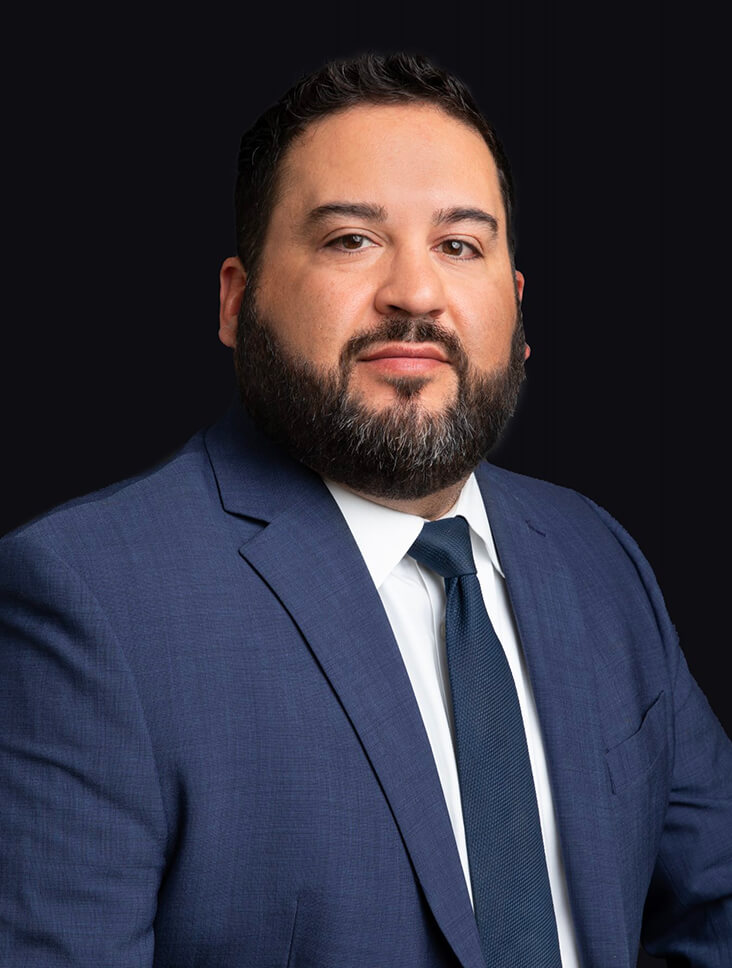
Miguel C. Mondragon is a tenacious and dedicated attorney who is fiercely committed to his clients and their legal outcomes. Recognizing that clients facing divorce or criminal charges are often in their most vulnerable state, Miguel acts as a passionate advocate, ensuring they have a voice within the legal system. Growing up in southern Colorado, Miguel developed a strong work ethic by working in construction, lumber, and brickyards while attending college. Before becoming an attorney, his interest in law was sparked by his work within the Larimer County Corrections system. While attending the University of South Dakota School of Law, he gained valuable experience working with East River Legal Services, the Colorado State Public Defenders Office, and Samuelson Law. Upon graduation, Miguel honed his skills first as a solo practitioner, then at Weaver & Associates, P.C., before founding Mondragon Law, where he specialized in criminal defense and family law. He brings this deep experience and tenacity to his current role...
DUI Law in Colorado
Colorado distinguishes between Driving Under the Influence (DUI) — requiring proof that the driver was substantially incapable of safely operating a vehicle — and Driving While Ability Impaired (DWAI), which requires proof of impairment to the slightest degree. A BAC of 0.08 or above creates a legal presumption of DUI. A BAC between 0.05 and 0.08 can support a DWAI charge. For commercial drivers, the per se limit is 0.04. Colorado also has a DUI per se provision for drivers with a THC blood concentration of 5 nanograms or more per milliliter.
Colorado’s expressed consent law means that by driving on Colorado roads, every driver consents to chemical testing — blood or breath — following a lawful DUI arrest. Refusal triggers automatic license revocation and can be used as evidence of consciousness of guilt at trial. The expressed consent advisement administered by the arresting officer must be given correctly — errors in the advisement are a defense issue we evaluate in every case.
DUI penalties in Colorado escalate significantly with prior convictions. A first offense carries 5 days to one year in county jail (with probation eligibility), fines up to $1,000, 9 months to 2 years license revocation, and mandatory public service. A third DUI is a Class 4 felony in Colorado. Fourth and subsequent offenses are also felonies. For military personnel, any DUI conviction — including a first offense — can trigger administrative action, security clearance review, and career consequences that dwarf the civilian sentence.
What Our Colorado Springs DUI Attorneys Challenge
The traffic stop: Law enforcement must have reasonable articulable suspicion to initiate a stop. Checkpoint stops have their own constitutional requirements. If the stop was unlawful, all evidence flowing from it — field sobriety tests, chemical tests, officer observations — may be suppressed. We scrutinize every stop for constitutional defects.
Field sobriety tests: The three standardized FSTs — horizontal gaze nystagmus, walk-and-turn, one-leg-stand — are presented as scientific but have meaningful limitations. Medical conditions, nervousness, footwear, uneven pavement, weather, and poor administration by the officer all affect reliability. Colorado Springs’ high altitude can also affect HGN results — a genuine and litigable issue in this jurisdiction. We challenge FST administration and interpretation in every case.
Breath test results: Breathalyzer devices used in El Paso County must be properly calibrated and maintained. We obtain calibration and maintenance records for every device and challenge results when those records reveal deficiencies. The 20-minute observation period required before a breath test is another procedural requirement we scrutinize in every case.
Blood test results: Blood draws must be conducted by qualified personnel under specific protocols. Chain of custody, storage conditions, fermentation of the sample, and laboratory methodology all affect reliability. We request independent testing of preserved blood samples when the facts support it.
The DMV hearing: The 7-day deadline to request a Colorado DMV hearing runs from the date of arrest. Missing it results in automatic license revocation. We request the DMV hearing immediately upon being retained — it is the first action we take on every DUI case.
DUI and Military Service in Colorado Springs
Colorado Springs’ large military population makes the intersection of DUI charges and military career consequences a recurring and critical defense consideration. A DUI conviction — even a first-offense misdemeanor — can affect a service member’s security clearance, particularly in the Air Force and Space Force communities where clearance is required for most career fields. Security clearance adjudicators consider criminal history, including alcohol-related offenses, under the Adjudicative Guidelines.
Beyond clearance implications, a DUI conviction can result in a General Officer Memorandum of Reprimand (GOMOR), bar to reenlistment, denial of promotion, and, in some cases, initiation of administrative separation proceedings. The severity of the military response depends on the rank, branch, specific command, and whether the service member has prior disciplinary history. We advise military clients on both the civilian defense and the parallel military implications from the outset of every DUI case.
For civilian defense contractor employees at Colorado Springs’ military installations, a DUI conviction can affect facility access badges, security clearances required for contract performance, and employment eligibility at defense contractor firms that maintain their own conduct standards. The civilian criminal consequences and the employment consequences must both be considered in developing defense strategy.
Why Burnham Law for DUI Defense in Colorado Springs
Immediate DMV hearing action. The 7-day deadline is the most time-critical action in any Colorado DUI case. We take this step before anything else on every new DUI case.
Military consequence awareness. Colorado Springs DUI defense requires attorneys who understand the military career implications of a conviction and factor those implications into every defense decision and plea negotiation.
El Paso County DUI experience. We handle DUI cases in El Paso County District Court regularly and know how the local DA’s office approaches these cases and what the realistic range of outcomes is for specific fact patterns.
Altitude and Colorado-specific defense issues. Colorado Springs’ elevation creates genuine and litigable issues around HGN field sobriety test reliability and physiological effects on BAC. We use these Colorado-specific defense arguments where the facts support them.
Frequently Asked Questions — Colorado Springs DUI
What is the difference between DUI and DWAI in Colorado?
DUI requires proof of substantial impairment — the driver was substantially incapable of safely operating a vehicle. DWAI requires proof of impairment to the slightest degree. DWAI is a lesser charge with lower penalties but still results in a criminal conviction, license points, and potential jail time. A BAC of 0.08 or above creates a presumption of DUI; a BAC between 0.05 and 0.08 can support DWAI. A first-offense DUI negotiated down to DWAI can make a significant difference in both the immediate consequences and the long-term record.
What happens to a military member’s career after a DUI conviction in Colorado Springs?
The military consequences of a DUI conviction depend on the branch, rank, command, and prior history, but can include a Letter of Reprimand or General Officer Memorandum of Reprimand (GOMOR), denial of promotion, bar to reenlistment, security clearance review or revocation, and in some cases initiation of administrative separation. The Air Force and Space Force communities in Colorado Springs are particularly clearance-dependent, making DUI convictions especially consequential for personnel in those communities. Aggressive civilian defense — ideally resulting in dismissal, diversion, or significant charge reduction — is the best protection against military career consequences.
Does Colorado’s high altitude affect DUI breath tests?
Altitude can affect the physiological factors involved in breath testing, and Colorado Springs’ elevation (approximately 6,000 feet) is a legitimate consideration in DUI defense. High altitude can affect breathing patterns, blood oxygen levels, and certain physiological responses that breathalyzer algorithms assume at sea level. Whether altitude is a viable defense argument depends on the specific facts of the case, the device used, and the available expert support. We evaluate altitude-related defense arguments in every Colorado Springs DUI case.
Can I refuse a breath test at a DUI checkpoint in Colorado Springs?
Colorado operates sobriety checkpoints that are constitutionally permissible under specific procedural requirements. At a checkpoint stop, officers typically conduct a preliminary investigation before deciding whether to request a roadside preliminary breath test (PBT). The PBT is voluntary and refusal cannot be used against you. If you are formally arrested for DUI and asked to submit to an evidentiary breath or blood test under expressed consent, refusal results in automatic license revocation and can be used as consciousness of guilt evidence at trial.
How long does a DUI stay on my Colorado record?
DUI and DWAI convictions in Colorado cannot be sealed under current law and remain on your criminal record permanently. They also remain available for enhancement purposes — prior DUI and DWAI convictions are used to elevate subsequent charges from misdemeanor to felony with no time limit on how old the prior conviction is. This permanence is one of the most important reasons to fight a DUI charge aggressively from the start rather than simply accepting a plea to resolve it quickly.
Schedule a Consultation with a Colorado Springs DUI Lawyer
A DUI arrest in El Paso County requires immediate action — particularly the 7-day DMV hearing deadline and, for military clients, prompt attention to the career implications. Burnham Law’s Colorado Springs DUI attorneys act quickly to protect your license, your record, and your career.
Call (303) 990-5308 or schedule a confidential consultation online. We defend DUI and DWAI charges throughout El Paso County and the Pikes Peak region.